

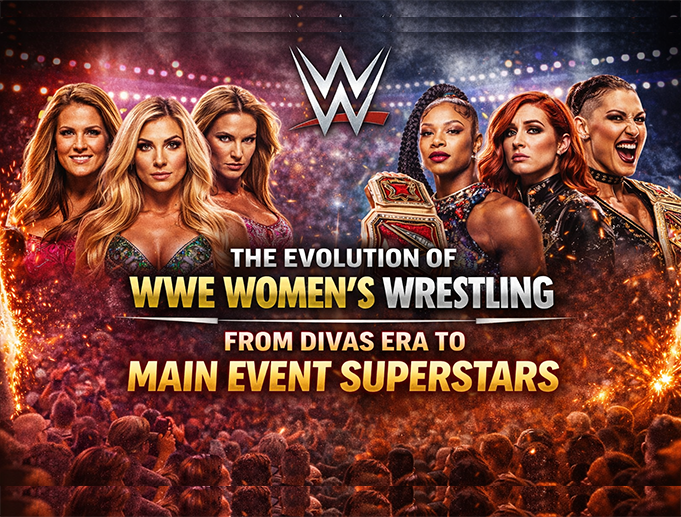
For decades, women in professional wrestling fought not only opponents inside the ring but also stereotypes outside of it. Today, however, women are among the biggest stars in the industry, headlining major events and delivering some of the most critically acclaimed matches in wrestling history.
The transformation of women’s wrestling in WWE is one of the most remarkable success stories in sports entertainment. What once began as a side attraction during the so-called Divas Era has evolved into a powerful movement where female superstars regularly headline premium events like WrestleMania, Royal Rumble, and SummerSlam.
Today’s WWE women’s division features world-class athletes, global superstars, and groundbreaking pioneers who changed the perception of women’s wrestling forever.
To understand how this transformation happened, we must explore the different eras that shaped the modern WWE women’s division.
The Early Days of Women’s Wrestling in WWE
Women’s wrestling existed in WWE long before the modern revolution, but it was rarely treated as a central attraction.
In the 1980s and early 1990s, WWE featured pioneers like The Fabulous Moolah and Alundra Blayze, who helped legitimize women’s wrestling during a time when opportunities were extremely limited.
These early trailblazers demonstrated that women could deliver serious wrestling matches rather than simply serve as entertainment segments.
One of the most memorable moments of this era occurred when Alundra Blayze held the WWE Women’s Championship, proving that technical skill and athletic ability could define women’s wrestling.
However, despite these early successes, women’s wrestling still struggled to gain equal recognition.
The Divas Era: Entertainment Over Athleticism
During the late 1990s and 2000s, WWE entered what fans now call the Divas Era.
The focus shifted heavily toward glamour, modeling, and entertainment segments rather than competitive wrestling. Women performers were often referred to as “Divas,” and matches were typically short and rarely featured on major cards.
Popular stars of this era included:
- Trish Stratus
- Lita
- Torrie Wilson
- Stacy Keibler
- Kelly Kelly
Despite the era’s criticism, several performers managed to showcase exceptional talent.
Trish Stratus: The Face of the Divas Era
Few names are as important to WWE women’s history as Trish Stratus.
Originally introduced as a fitness model and manager, Stratus worked tirelessly to improve her in-ring skills. Over time, she became one of the most respected female wrestlers in WWE history.
Her rivalry with Lita helped elevate women’s wrestling and proved that female performers could deliver intense, emotional matches.
Their legendary match on WWE Raw in 2004 remains one of the most iconic moments in women’s wrestling.
The Turning Point: The Women’s Revolution
By the early 2010s, wrestling fans began demanding better opportunities for female performers.
The turning point came with the rise of a new generation of highly trained wrestlers in WWE NXT.
This era introduced future megastars such as:
- Charlotte Flair
- Becky Lynch
- Sasha Banks
- Bayley
These athletes became known as the “Four Horsewomen” of WWE women’s wrestling.
Their matches in NXT were longer, more competitive, and more emotionally engaging than anything previously seen in the women’s division.
The End of the Divas Championship
One of the most symbolic moments in WWE history occurred in 2016 when the company officially retired the WWE Divas Championship.
It was replaced with the WWE Raw Women’s Championship, signaling the end of the Divas Era and the beginning of a new chapter focused on athletic competition.
This change represented WWE’s commitment to treating female wrestlers as true athletes rather than side attractions.
WrestleMania Main Event: A Historic Milestone
The evolution of WWE women’s wrestling reached a historic moment at WrestleMania 35.
For the first time ever, women headlined the biggest event in professional wrestling history.
The main event featured:
- Becky Lynch
- Charlotte Flair
- Ronda Rousey
This match represented the culmination of decades of struggle and progress for women in WWE.
When Becky Lynch emerged victorious holding both championships, it became one of the most iconic moments in modern wrestling.
The Modern Era of WWE Women’s Wrestling (2020–2026)
Today, WWE’s women’s division is stronger than ever.
Superstars like:
- Bianca Belair
- Rhea Ripley
- Iyo Sky
- Asuka
are delivering world-class performances on a weekly basis.
These athletes combine incredible strength, athleticism, and storytelling ability.
Rhea Ripley: Dominating the Modern Era
One of the most dominant stars of the modern division is Rhea Ripley.
With her intimidating presence and powerful wrestling style, Ripley quickly became one of WWE’s biggest attractions.
Her championship reigns and rivalry with top stars have helped solidify the credibility of today’s women’s division.
The Global Impact of WWE Women’s Wrestling
The evolution of WWE women’s wrestling has influenced the entire industry.
Promotions worldwide have expanded their women’s divisions in response to WWE’s success.
This movement has inspired a new generation of aspiring wrestlers who now see women’s wrestling as a legitimate career path.
The Future of Women’s Wrestling in WWE
As we move deeper into the 2020s, the future looks incredibly bright.
Young rising stars from WWE NXT continue entering the main roster, bringing fresh talent and exciting rivalries.
Women’s wrestling is no longer an experiment — it is now one of the pillars of WWE programming.
Conclusion
The journey from the Divas Era to today’s main-event superstars represents one of the most important transformations in professional wrestling history.
Through the dedication of pioneers, the passion of fans, and the incredible talent of modern athletes, WWE women’s wrestling has evolved into a powerful global phenomenon.
Today, female superstars headline major events, inspire millions of fans, and prove that the future of professional wrestling belongs to everyone.