

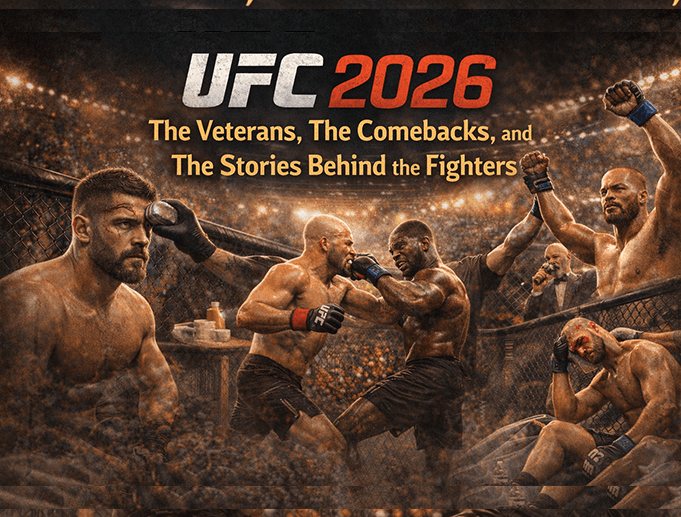
The UFC is often described as a young man’s sport. The logic is simple: younger fighters are faster, recover more quickly, and have not accumulated the wear and tear that comes with years of training and competition. By this reasoning, veterans should fade away, replaced by the next generation.
But the sport does not work that way. Veterans persist. They adapt. They find ways to win that do not rely on the athleticism of their youth. They become wiser, more efficient, more dangerous in different ways.
In 2026, the UFC roster features an extraordinary collection of veteran fighters. Some are chasing one last title run. Others are simply competing because they love the sport and cannot imagine walking away. All of them have stories worth telling.
At Ringside Wrestler, we have spent time with the veterans, the comeback artists, and the fighters whose journeys reveal something true about the sport. These are their stories.
The Legends Still Competing
Every generation produces fighters who seem to defy time itself. They compete into their late thirties and early forties, beating athletes young enough to be their children. They adapt their styles as their bodies change, replacing explosive athleticism with ring IQ and efficiency.
The Mindset of Longevity
What separates these fighters from their peers who fade quickly is not just physical conditioning. It is mental adaptability. They understand that the fighter they were at twenty-five cannot exist at thirty-eight. They build new versions of themselves, different but equally dangerous.
The best veterans also manage their training smarter. They do not need to prove anything in the gym. They conserve their bodies for fight night, trusting that decades of experience have built instincts that younger fighters lack.
They also understand the mental game at a deeper level. They have been through everything: victory and defeat, glory and disappointment, adulation and criticism. Nothing surprises them. Nothing shakes them. That stability becomes an advantage when younger fighters crack under pressure.
The Physical Reality
Training and competing into one’s late thirties requires a different approach. Recovery takes longer. Injuries that once healed in days now linger for weeks. The accumulation of damage becomes harder to manage.
Veterans who sustain long careers have usually figured out how to work around these realities. They pick their spots in training, avoiding unnecessary wear and tear. They invest in recovery modalities that younger fighters ignore. They listen to their bodies in ways that take years to learn.
The physical decline is real, but it can be managed. The fighters who manage it best are the ones who stay competitive longest.
Charles Oliveira: Redemption and Legacy
Charles Oliveira’s journey through the UFC has been defined by moments of triumph and moments of despair. In 2026, he added another chapter to a story that grows more remarkable with each passing year.
The First Meeting
Almost a decade before their rematch, Oliveira and Max Holloway first met in the summer of 2015. That fight ended in disappointment for the Brazilian, who suffered a freak shoulder injury that forced an early stoppage. The loss was frustrating because it left questions unanswered.
Could Oliveira have competed if not for the injury? Would the outcome have been different? The questions lingered for years, unresolved and unanswerable.
The Rematch
At a major UFC event in early 2026, Oliveira got his answer. In the main event, he faced Holloway again, this time with the symbolic BMF title on the line. The stakes were different but no less significant.
Oliveira opened the fight with a low kick to Holloway’s lead leg. Holloway quickly answered with sharp combinations that landed cleanly. But Oliveira did not shy away. He fired back with power before taking the fight to the mat.
From that moment, the pattern was set. Oliveira used his size and superior grappling to overwhelm the defending champion. He secured takedowns, controlled position, and unleashed relentless ground and pound. Round after round, the formula worked.
In the first round, Oliveira took side control and established dominance. He mixed submission attempts with punishing elbows and punches. From the back position, he hunted a rear naked choke that Holloway managed to survive, but the message was clear.
The second round followed the same pattern. Oliveira dragged Holloway down along the side of the Octagon, worked from guard, and eventually transitioned back to his opponent’s back. Patient but relentless, he hunted the submission while landing significant strikes.
By the third round, Holloway had few answers. Oliveira continued to impose his will, mixing takedowns with ground strikes and submission attempts. The dominance was complete.
When the final bell sounded, the result was never in doubt. Oliveira had earned the victory and the BMF title, answering questions that had lingered for nearly a decade.
The Meaning of the Moment
For Oliveira, the victory represented more than just another win. It was redemption for a moment that had haunted him. It was validation of his evolution as a fighter. It was proof that his best moments were not behind him.
The BMF title carries symbolic weight, but for Oliveira, the symbolism mattered less than the achievement itself. He had faced a legend and emerged victorious. He had answered the questions that remained from their first meeting. He had added another chapter to a Hall of Fame career.
What comes next for Oliveira remains to be seen. At his stage of career, every fight could be his last. But if this was a final statement, it was a powerful one.
The Comeback Artists
Some of the most compelling stories in the UFC involve fighters who were counted out, who lost multiple fights in a row, who seemed destined for the regional circuit or early retirement. Then something clicked.
The Moment of Decision
Every comeback begins with a moment of decision. The fighter looks in the mirror and asks a difficult question: Am I willing to do what it takes to get back?
Some answer no. They accept that their best days are behind them and move on to the next phase of life. Others answer yes, and that yes sets everything in motion.
The decision to attempt a comeback is not rational. The odds are long. The road is hard. The potential for failure is real. But something inside the fighter refuses to accept that the story is over.
The Changes That Matter
Comebacks rarely succeed through sheer willpower alone. Something has to change. A new training camp. A different nutritionist. A revised approach to the mental game.
The fighters who successfully come back are the ones who identify what went wrong and fix it. They do not repeat the same mistakes and hope for different results. They evolve.
Sometimes the change is dramatic: switching camps, moving to a new weight class, overhauling their entire approach. Sometimes it is subtle: improved discipline, better recovery, sharper focus. Either way, something has to be different.
The Support System
No fighter comes back alone. Behind every successful comeback is a support system: coaches who believed when no one else did, training partners who pushed through hard sessions, family members who provided stability.
These support systems absorb some of the pressure, allowing the fighter to focus on the task at hand. They provide honest feedback when things are not working. They celebrate small victories along the way.
The best support systems also know when to push and when to pull back. They understand the fighter’s psychology and adjust accordingly. This emotional intelligence is as important as any technical instruction.
Max Holloway: The Blessed Era Continues
Max Holloway has been competing at the highest level for over a decade. In 2026, he remains relevant, dangerous, and beloved by fans who have watched him grow from a raw teenager into a seasoned veteran.
The Evolution of Style
Holloway’s fighting style has evolved significantly over the years. The young Holloway was volume-based, throwing combinations in bunches and overwhelming opponents with sheer output. It was effective but costly. He took damage to deliver damage.
The veteran Holloway is more measured. He picks his spots more carefully. He manages distance with greater precision. He understands that every exchange carries risk and chooses his battles accordingly.
This evolution has extended his career. By fighting smarter, he has reduced the accumulation of damage while remaining competitive against elite opposition. He may not be the same fighter he was at twenty-five, but he is a better fighter in different ways.
The BMF Loss
The loss to Oliveira in early 2026 was a setback, but it did not define Holloway’s career. Champions lose. Legends lose. What matters is how they respond.
For Holloway, the response was typical: grace in defeat, acknowledgment of his opponent’s superiority on that night, and a quiet determination to return stronger. He has been through this before. He knows the path back.
The question is whether another title run remains possible. At his age, with his mileage, the window is closing. But Holloway has proven doubters wrong before. Counting him out would be premature.
The Legacy Secured
Regardless of what happens in the remainder of his career, Holloway’s legacy is secure. He held the featherweight title. He defended it multiple times. He delivered some of the most memorable performances in UFC history.
Fans will remember the volume striking, the durability, the willingness to stand in the center of the Octagon and trade with anyone. They will remember the smile, the confidence, the joy he brought to competition.
That is the mark of a true legend. Not just what they accomplished, but how they made fans feel while accomplishing it.
The Veterans Holding the Line
For every legend headlining pay-per-views, there are veterans filling out the undercard, testing prospects, and providing the depth that makes the UFC roster function.
The Gatekeeper Role
The term “gatekeeper” sounds dismissive, but the role is essential. Gatekeepers are the fighters ranked just below title contention, the veterans who have been in the Octagon with everyone, the athletes who separate prospects from pretenders.
Gatekeepers do not get the glory of championship belts or the biggest pay-per-view shares. What they get is respect from those who understand the sport. They know that every young fighter who passes through them becomes a better competitor for the experience.
The best gatekeepers also know that their role can change quickly. One upset victory, one string of impressive performances, and suddenly they are contenders again. The door swings both ways.
The Experience Factor
Veterans bring something that prospects cannot match: experience. They have seen every style, faced every situation, navigated every challenge. Nothing surprises them.
This experience manifests in subtle ways. They manage the pre-fight week better, conserving energy while prospects burn nervous adrenaline. They make in-fight adjustments more quickly, recognizing patterns and exploiting weaknesses. They handle adversity without panicking, trusting that they have been through worse and survived.
Against younger, faster, stronger opponents, this experience can be the difference between victory and defeat.
The Financial Reality
Not every veteran fights for glory or championships. Some fight because they need the money. The gap between the top of the roster and the bottom remains enormous, and for many fighters, every appearance is essential to their financial survival.
These veterans fight hurt. They take short-notice replacements. They accept unfavorable matchups. They do what they have to do to stay in the sport and keep the income flowing.
Their sacrifices rarely make headlines, but they are the backbone of the organization. Without them, there would be no undercards, no depth, no opportunities for prospects to develop.
The Mental Game of the Veteran
As fighters age, the mental game becomes increasingly important. Physical advantages diminish. Experience becomes the primary weapon.
Fighting Smarter, Not Harder
Veterans win by fighting smarter. They conserve energy, picking spots to engage rather than pressing constantly. They target weaknesses rather than headhunting. They take what the opponent gives rather than forcing what they want.
This approach may not produce the most exciting fights, but it produces wins. And for veterans whose careers are finite, wins are what matter.
Managing the Narrative
Veterans also understand the importance of narrative. They know that how they present themselves affects how fans perceive them, how promoters book them, how the organization values them.
Some embrace the grizzled veteran role, trading on nostalgia and respect. Others fight the perception that they are past their prime, using every victory as evidence that they remain relevant. Still others ignore the narrative entirely, focusing solely on the next opponent and the next fight.
The fighters who manage their narratives best are often the ones who extend their careers longest. They remain marketable even as their physical skills decline.
The Endgame
Every veteran eventually faces the same question: when is it time to walk away?
Some leave too early, walking away with skills still sharp and fights still available. They wonder for years what might have been.
Others stay too long, accumulating damage and tarnishing legacies. They become cautionary tales about the sport’s unforgiving nature.
The ones who time it perfectly are rare. They leave on their own terms, with their health intact and their dignity secure. They transition to the next phase of life with peace rather than regret.
The Unfinished Business
Many veterans continue fighting because they have unfinished business. A loss they want to avenge. A title they never captured. A performance they want to erase.
The Rematch
Few things motivate a fighter like a loss. The memory of defeat lingers, fueling training sessions and shaping game plans. The opportunity to avenge that loss becomes an obsession.
When rematches happen, the stakes are personal. The fighter is not just competing for rankings or money. They are competing to erase a memory, to prove that the first result was an aberration, to reclaim something that was taken from them.
These fights often deliver beyond expectations because the emotional investment is so high.
The Title Dream
For fighters who have never held gold, the dream of becoming champion never dies. Even as the odds lengthen and the window closes, they believe that one more win, one more performance, could change everything.
This belief is irrational. The numbers say they will never reach the top. But fighters are not rational beings. They believe because they have to believe. Without that belief, there would be no reason to continue.
The Final Statement
Some veterans fight for one last statement, one performance that reminds everyone who they were at their peak. They want to walk away having shown that the old magic still exists, even if only for one night.
These final statements are often the most memorable moments of a career. They capture something essential about the fighter: the pride, the skill, the refusal to fade quietly.
The Post-Fight Reality
The cameras stop rolling. The crowd goes home. The veteran is left with the consequences of what just happened.
The Winner’s Night
Victory brings immediate relief and joy. The months of sacrifice, the weeks of suffering, the minutes of danger—all of it was worth it. For one night, the winner is the center of their world.
But victory also brings expectation. The next opponent is already being discussed. The pressure to repeat, to defend, to prove it was not a fluke—that pressure begins building immediately.
Winners celebrate, but they also know that the celebration cannot last. There is always another fight.
The Loser’s Morning
The morning after a loss is the darkest time in a fighter’s life. The body hurts. The mind replays every mistake. The future, which seemed so clear before the fight, now feels uncertain.
Losses change trajectories. A contender becomes a gatekeeper. A prospect becomes a question mark. A veteran becomes a comeback story waiting to happen or a cautionary tale about fighting too long.
How fighters handle the morning after determines what happens next. The ones who learn from defeat find their way back. The ones who are broken by it fade away.
The Long-Term Cost
Fighting leaves marks that do not fade. Concussions accumulate. Joints deteriorate. The body that seemed invincible at twenty-five aches constantly at forty-five.
Some fighters manage these costs better than others. They save money, invest wisely, build second careers. They transition from athlete to something else before the sport forces them out.
Others struggle. The sport that gave them purpose takes their health and offers nothing in return. Their post-fighting years are defined by pain, regret, and financial hardship.
This is the part of the story that no highlight reel captures.
Why Veterans Keep Fighting
Given everything we have discussed—the physical toll, the emotional weight, the uncertain future—why do veterans keep fighting?
The answers are as varied as the fighters themselves.
Some fight because they love it. The competition, the preparation, the moment of truth—these things give their lives meaning that nothing else can replace.
Some fight because they need the money. The UFC pays well at the top, but for those outside the headlines, every fight is essential to financial survival.
Some fight because they do not know who they would be without it. The sport has defined them for so long that the idea of walking away is terrifying.
Some fight because they believe, against all evidence, that their best moment is still ahead. They chase one more victory, one more performance, one more night under the lights.
Whatever the reason, veterans keep showing up. They keep training. They keep stepping into the cage.
And we keep watching, grateful for the chance to witness their journeys.
Final Thoughts
The UFC in 2026 is more than just rising stars and championship fights. It is veterans chasing redemption. It is comeback artists defying expectations. It is fighters writing the final chapters of stories that began years ago.
Charles Oliveira added a chapter in early 2026, answering questions that had lingered for nearly a decade. Max Holloway showed that legends can lose with grace and still matter. Countless other veterans filled undercards, tested prospects, and reminded us why we love this sport.
Their stories may not always make headlines, but they are essential to the fabric of the UFC. Without them, the organization would be poorer, the sport less rich.
So the next time you watch a fight card, pay attention to the veterans. Watch how they move, how they think, how they compete. There is wisdom there, earned through years of battle.
And there is beauty in that wisdom, if you know how to see it.
Ringside Wrestler is your home for UFC coverage, fighter stories, and the human side of mixed martial arts. Check back daily for new content and comprehensive analysis of everything happening in the sport.